

Optimal Binary Search Tree Algorithm Explained
Explore the Optimal Binary Search Tree algorithm 📚 in design and analysis of algorithms. Learn optimization, dynamic programming, construction & applications.
Edited By
Amelia Reed
Binary Search Tree (BST) is a fundamental data structure used widely in computer science for organising and managing data efficiently. It helps perform quick searching, insertion, and deletion operations, which is especially useful in applications requiring fast data retrieval.
A BST is a tree-like structure where each node contains a value, and it follows a simple rule: for any node, values in its left subtree are smaller, and values in its right subtree are larger. This property ensures that search operations can skip half of the nodes at every step, much like how you look up words in a dictionary by dividing pages.

Why BST matters in financial and trading systems? It enables quick access to stocks, prices, and transactions. For example, if you want to find a particular stock price from thousands of records, a BST allows you to locate it in much less time than scanning the whole list from start to end.
Nodes: Each stores a unique value such as a stock price or transaction ID.
Left child: Contains values smaller than the parent node.
Right child: Contains values greater than the parent node.
No duplicates: Standard BST does not store duplicate values.
Consider you have stock prices: 30, 15, 50, 10, 20, 40, 60.
In a BST:
30 will be the root.
15 goes to left of 30.
50 goes to right of 30.
10 goes to left of 15.
20 goes to right of 15.
40 goes to left of 50.
60 goes to right of 50.
This organisation helps locate prices quickly by comparing each time you descend the tree.
A BST reduces search complexity from O(n) in lists to O(log n) on average, making it ideal for applications handling large data, like stock market analysis and financial record keeping.
Understanding BST prepares you to build more complex data structures and algorithms that traders and analysts rely on daily for decision making and risk management.
Binary Search Tree (BST) is critical for anyone looking to deepen their understanding of data structures, especially if you deal with large sets of financial data or stock market analysis. It offers a way to organise data so that searching, inserting, or deleting items happens quickly and efficiently. For example, when analysing transactions or trading data, BST helps keep the records sorted without needing to reorder the entire list each time.
A Binary Search Tree is a type of binary tree where each node holds a key and satisfies a specific ordering property. Every node’s left subtree contains keys less than the node’s own key, while the right subtree contains keys greater than it. This ordered structure allows operations like searching to ignore half of the tree at each step. In practical terms, it means you can quickly find an element compared to scanning through an entire list.
BST has a few simple but powerful traits:
Each node has at most two children: left and right.
Left child’s key is always smaller than the parent’s key.
Right child’s key is always larger than the parent’s key.
Duplicate entries are generally not allowed, ensuring each value’s uniqueness.
These make BST particularly useful when you need orderly data storage with fast retrieval, such as accessing client portfolios or stock prices sorted by value.
BST significantly improves the efficiency of searching operations. Since the tree is organised, you don't have to scan every element. Instead, you compare keys step-by-step, moving left or right depending on the key’s value until you find what you need or confirm its absence. For instance, if you want to check the price of a particular share in a sorted listing, BST allows you to find it in logarithmic time, much faster than linear search.
Compared to other trees like binary trees or heaps, BST offers more precise control over data order. This ordering makes inorder traversal of a BST produce sorted data naturally, which is especially handy when you want sorted reports for trading analysis. Unlike heaps, BST supports fast searching for any key, not just finding the maximum or minimum.
Understanding BST is essential because it combines efficient sorting and searching, two operations that financial professionals handle daily. Its structure ensures scalability and speed, which are must-haves in trading algorithms and financial data management.
Understanding the basic properties and structure of a Binary Search Tree (BST) is key to grasping how it helps in organising and searching data efficiently. These properties guide how nodes relate to each other, ensuring operations like insertion, search, and deletion run smoothly and quickly. Let’s explore these fundamentals clearly.
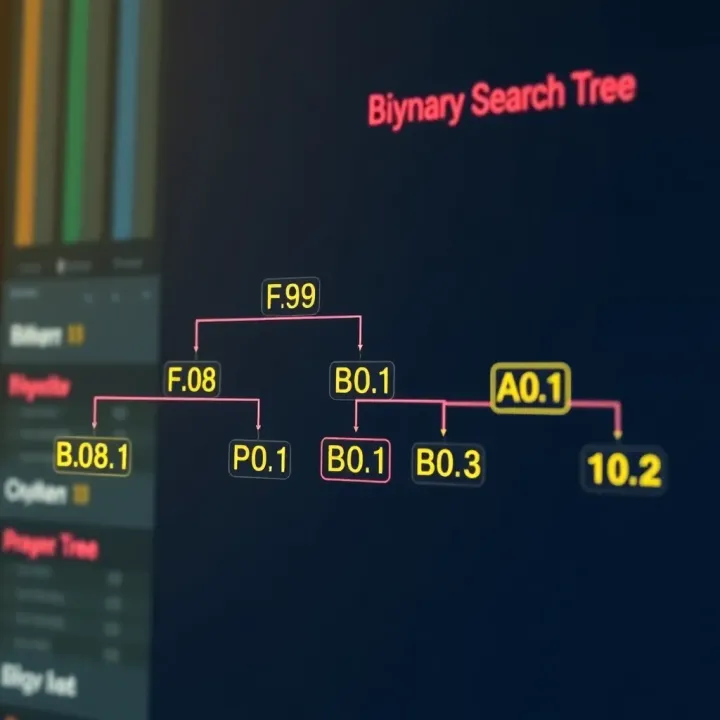
The root node is the topmost node in a BST. It serves as the entry point for all operations like searching or inserting data. Think of it as the CEO of the tree—everything starts here. For example, if your BST is storing stock prices, the root node might hold the initial reference price. From there, every decision branches out.
Each node in the BST can have up to two children: a left child and a right child. The left child holds values less than the parent node, while the right child holds values greater than the parent. This strict division helps keep the tree ordered, making it easier to find where new data fits or where existing data is stored. For instance, in a portfolio management system, the left child might represent shares with lower prices, and the right child those with higher prices.
A BST follows basic binary tree rules: every node can have zero, one, or two children, but the key is how these children relate in value. This structure limits complexity, which keeps the data organised systematically. It also avoids scenarios like a node having three children, which would complicate the search or insertion process.
All nodes in the left subtree of any node contain values less than the node itself. Practically, if you are searching for a particular value, and it’s smaller than the current node, you simply move to the left child to continue searching. This guides efficient navigation through the tree.
Similarly, all nodes in the right subtree have values greater than the node. When the value you seek is higher, you move right. In financial software, such a structure simplifies locating a security's price quickly when the tree size grows large.
BSTs do not allow duplicate nodes. This ensures unique keys for every node, simplifying search and management. For example, in a stock trading system, each stock symbol would be unique, preventing confusion caused by duplicate entries.
Maintaining these basic properties ensures that the BST remains balanced and efficient, allowing faster data retrieval compared to unsorted lists or arrays.
By mastering these concepts, you’ll understand how BSTs keep data organised and enable efficient operations, making them highly relevant for finance-related data management and analysis.
Binary Search Trees (BST) become truly useful because of their core operations: insertion, searching, and deletion. These operations allow BSTs to store, find, and modify data efficiently, which is why they are vital in programming and data management. Getting a firm grip on how these core operations work ensures you can implement BSTs effectively in applications like databases, file systems, and even stock market analysis tools.
Insertion in a BST starts at the root node. You compare the new value with the current node: if smaller, move left; if greater, go right. This process continues recursively until you find an empty spot where the new node fits. For example, if you want to insert ₹25 lakh as an investment value into a BST storing portfolio amounts and your root node has ₹30 lakh, you move left until the appropriate empty leaf is reached.
Each insertion maintains the BST property by placing nodes so that left subtrees only contain smaller values and right subtrees larger ones. This strict order keeps searching efficient. If the BST property weren’t held after each insertion, the search operation could degrade to a linear scan, losing the advantage BSTs provide.
Searching also begins at the root. You compare the target value with the current node’s key. If equal, you’ve found it; if smaller, go left; if larger, go right. This eliminates half the remaining nodes every step, making searches faster than linear methods.
The average time complexity for searching in a balanced BST is O(log n), where n is the number of nodes. It means the number of comparisons grows slowly even as the dataset size increases, making BSTs handy for large sets of data like stock prices or financial transactions. However, in the worst case (skewed BST), the time complexity can degrade to O(n), so balancing the tree is critical for performance.
Deleting nodes in BST requires handling three main cases:
Leaf node: The node has no children, so you simply remove it.
One child: Replace the node with its single child to keep the tree connected.
Two children: Find either the in-order predecessor (largest in left subtree) or successor (smallest in right subtree) to replace the node, then delete that node.
For instance, if a node representing ₹10 lakh needs deletion and it has two children, replacing it carefully ensures the BST property isn't broken.
After deletion, the tree must maintain its BST property and remain optimally balanced if possible. Adjustments like replacing with in-order successors or predecessors ensure this. In financial applications where data integrity matters, such careful restructuring guarantees quick future searches and accurate data.
Understanding insertion, searching, and deletion clearly helps you implement BSTs that work efficiently, especially when handling complex datasets like investment portfolios or transaction records.
These core operations form the backbone of BST’s usefulness, blending structure and flexibility to manage data smartly.
Traversal in a Binary Search Tree (BST) refers to visiting all nodes in a specific order to access or process their values. This is crucial for operations like printing data, searching, or modifying nodes systematically. For traders and analysts who deal with sorted datasets or hierarchical information, understanding traversal helps in efficiently extracting and analysing data.
Left-root-right sequence means first visiting the left subtree, then the root node, and finally the right subtree. This order respects the BST property, where the left child holds smaller values and the right child holds larger ones. Imagine you start by checking all items smaller than a given number before the number itself, and then items larger than it.
This sequence is particularly useful because it visits nodes in ascending order. When you perform inorder traversal, you get the data sorted automatically without any extra sorting step. For anyone dealing with financial data like stock prices or transaction records, this approach ensures you can retrieve information in order.
Resulting sorted output means that the traversal produces a naturally ordered list of the BST's elements. For example, if you have a BST representing daily closing prices, an inorder traversal will output these prices sorted from lowest to highest. This eliminates the need to sort separately, saving time and computational effort in data processing.
Basic procedures differ from inorder traversal. Preorder traversal visits the root first, then the left child, and finally the right child. Conversely, postorder traversal visits the left and right children first and processes the root last. These methods follow systematic orders to visit all nodes but serve different purposes.
Preorder is useful when you want to copy or replicate the tree structure because it processes the parent before its children. Postorder is handy when you need to delete nodes in a safe manner, such as clearing resources or memory, since it tackles children before the parent.
Use cases for these traversals are practical in programming and data management. In trading software, preorder traversal can help reconstruct data trees after exporting or transmitting them. Postorder traversal suits situations like balancing or pruning a tree, where nodes are removed starting from leaves upward, avoiding dangling references.
Traversals are not just academic concepts—they directly impact how efficiently financial systems extract and organise data, influencing performance and accuracy.
In summary, mastering traversal techniques enables you to handle BSTs effectively, which is essential for applications dealing with large or dynamically changing datasets in the stock market or financial analysis.
Binary Search Tree (BST) finds its importance in various real-world scenarios due to its efficient search, insertion, and deletion operations. It is not just a theoretical data structure but a practical choice when working with sorted data or when quick lookup is needed.
In day-to-day software systems like inventory management or even stock market data analysis, BST helps to manage and access data quickly. For example, a stockbroker needing to search through thousands of stock prices can use a BST-based system to locate the required price point faster than scanning a list manually or linearly searching an array.
When it comes to sorting, the inorder traversal of a BST produces sorted output naturally. This makes BST suitable for applications where sorted data retrieval is frequent, such as ranking investors by portfolio value or listing companies by market capitalisation.
Compared to arrays and linked lists, BST offers faster search and insertion times under typical conditions. While arrays require shifting elements during insertion or deletion, BST only restructures portions of the tree, which usually results in better performance for dynamic datasets. Linked lists permit easy insertion but have slow search as they require sequential traversal. BST is a balanced choice offering logarithmic average-time complexity for these operations.
In software development, Indian tech firms building financial analysis tools or stock trading platforms often implement BSTs to efficiently organise and process huge datasets. For instance, apps like Zerodha or Upstox may rely on tree-based structures behind the scenes to keep stock information updated and searchable in real time.
Educationally, learning BST in India forms a core part of computer science courses, including engineering and diploma studies. It is also a favourite topic in competitive exams like GATE and campus placement tests, as it helps students grasp essential concepts in algorithms and data organisation. Understanding BST prepares students for roles in software development, data analysis, and fintech sectors where handling organised data quickly is key.
Efficient data handling using BST can significantly reduce the time taken for crucial operations like searching and sorting, which are everyday requirements in finance-related technology and applications.
This practical relevance makes BST not only a fundamental topic to learn but also a valuable tool to apply in India’s rapidly growing software and fintech industries.
Explore the Optimal Binary Search Tree algorithm 📚 in design and analysis of algorithms. Learn optimization, dynamic programming, construction & applications.

🤖 Explore how linear search and binary search algorithms work, their stepwise methods, efficiency, and best use cases to handle data smoothly in your code.

Learn how to implement a binary search program 🖥️ with clear steps, coding examples, benefits, pitfalls, and tips to optimise your code for smarter, faster searching.

🔍 Explore Linear vs Binary Search algorithms: learn their workings, pros, cons, and practical tips to pick the best search method for your data!
Based on 15 reviews