
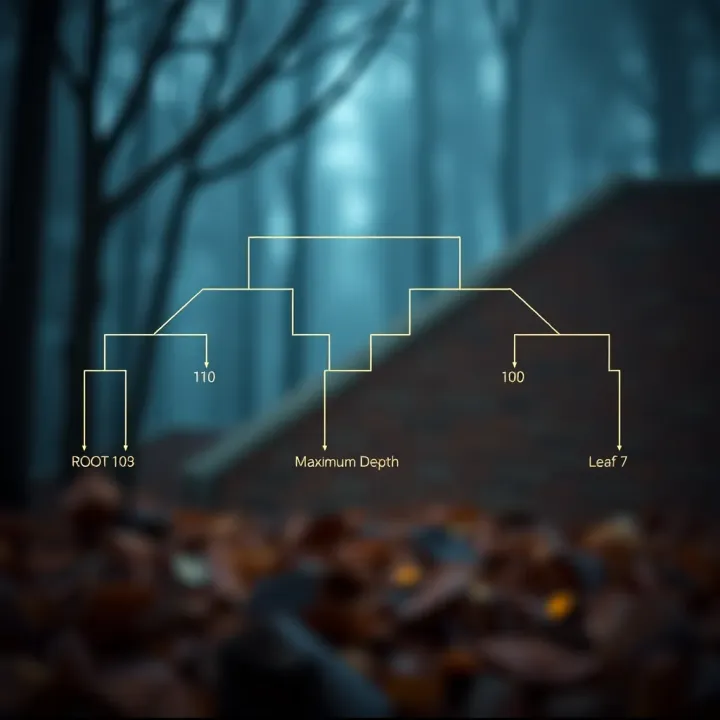
Understanding Maximum Depth of a Binary Tree
Learn how to find the maximum depth of a binary tree 🌳 using clear methods like recursion and iteration. Perfect for programmers and CS enthusiasts! 💻📚
Edited By
Amelia Hughes
Binary trees are one of those fundamental concepts that pop up often in coding interviews, data structure courses, and real-world computing problems. Understanding how deep these trees can get—known as the maximum depth—is essential, especially for anyone working with algorithms or data organization.
Why care about maximum depth? Well, it tells us how far down the tree we can travel from the root before hitting the leaves. This information is handy in many scenarios: for instance, optimizing search times in financial databases or balancing portfolios dynamically in trading systems. Additionally, maximum depth helps assess the efficiency of tree-based operations, like insertion and retrieval, which are common in financial software and analytics.
This article will break down the concept of maximum depth in binary trees, show you how to calculate it using different methods (both recursive and iterative), and explain related ideas like tree height, balanced trees, and their complexity. Whether you're a student diving into data structures or a financial analyst curious about the algorithms behind your tools, this guide aims to give you clear, actionable knowledge.
Getting a grip on maximum depth isn’t just academic—it’s a key part of making sure tree operations run smoothly and efficiently in practical applications.
Let's start by looking at what maximum depth really means and why it matters in tree structures that underpin many algorithmic processes in finance and computing.
To get a grip on the maximum depth of a binary tree, you first need to understand what binary trees are and the idea of depth within them. Think of a binary tree as a family tree — it branches out with nodes having up to two children, creating a structure that’s easy to navigate. This simplicity makes binary trees a fundamental tool in various applications, from searching for stock prices to managing large sets of financial data.
Knowing the depth of a tree, especially its maximum depth, helps you judge how efficient operations like searching or sorting will be. For instance, if you’re investigating company records stored in a tree and the tree is deeper than it needs to be, your queries might take longer than expected. Hence, having a solid grasp of tree depth improves both the system’s design and performance.
A binary tree is a data structure where each node holds a value and links to at most two other nodes, commonly called the left and right child. Imagine you’re structuring your investment portfolio: each node could represent a category, like stocks or bonds, and its children could break down these categories further by sector or risk level. This setup makes it easier to search and manage information hierarchically.
The key is that every node doesn’t have to have two children; sometimes, it just has one or none. This flexibility mirrors many real-life hierarchical systems in finance where options branch out unevenly.
Depth refers to how far a node is from the root (top) of the tree, starting at zero for the root itself. Height, on the other hand, measures how far a node is from its furthest leaf (or bottom node). For maximum depth, we're interested mainly in the height of the root node, which tells us the longest downward path in the entire tree.
From a trading software perspective, understanding this difference is crucial because operations might depend on reaching the deepest point of the tree, such as finding the oldest transaction in a system where data grows by adding leaves deep down.
Levels are a straightforward way to think about depth and height. The root node resides at level 0, its children are at level 1, and so forth down the tree. The maximum depth corresponds to the highest level where nodes exist.
Why does this matter? In financial algorithms, traversing level by level (like reading transaction logs one day at a time) can simplify processing. For example, a breadth-first search uses levels to scan nodes systematically — this technique is useful for batch-update scenarios in a trading platform.
Knowing the maximum depth gives you an idea of the tree’s complexity and potential bottlenecks. A deeper tree means more steps to reach the furthest data point, possibly slowing down search operations.
In financial databases, where milliseconds matter, optimizing for shallower trees can mean faster query times and better performance under load. Also, balancing the tree (i.e., keeping it from becoming too deep) ensures that updates and lookups remain efficient, which is key for real-time analytics and decision making.
'In finance, data structure efficiency isn’t just about neat code — it directly impacts the speed and accuracy of your analysis and trading decisions.'
Calculating the maximum depth of a binary tree is more than a mere academic exercise — it’s fundamental in understanding the structure's efficiency and performance. For anyone dealing with data processing, be it in financial systems or decision trees, knowing how deep a tree stretches can dictate how fast you can retrieve information or how much memory your algorithm eats up.
Take, for example, a decision-making process in stock trading algorithms. The maximum depth can impact how quickly a system arrives at a buy or sell signal. A deeper tree could mean more detailed analysis but also longer computation time, which can be a deal-breaker where every millisecond counts.
The recursive approach to finding maximum depth is classic and intuitive. Imagine the tree like a family genealogy chart — to find the longest line from the ancestor to the youngest descendant, you check every branch recursively. The function calls itself to dive down each child node until it hits the end, then bubbles back up with the maximum depth found so far.
This method fits well into programming languages with native support for recursion, such as Python or Java, and closely matches the natural definition of a tree. It’s like peeling away layers step-by-step, which is straightforward but needs care to avoid stack overflow on very deep trees.
In recursion, the base case stops the process — when you hit a null node (meaning no more children), the depth is zero. Everything else is the recursive case: the function calls itself for both left and right children, then returns the larger depth plus one (for the current node).
This pattern ensures you measure depth accurately regardless of how skewed the tree might be. For example, if you have a tree with a single long chain of nodes on one side and a stubby branch on the other, the recursion picks the longer path.
Unlike recursion, the iterative approach loops through the tree level by level, and the tool of choice here is a queue. Starting from the root, nodes are enqueued and dequeued systematically, ensuring you process one level fully before moving onto the next.
Think of it like handling batches of data; you don’t jump deep immediately but cover all nodes layer by layer. This is especially practical in environments with limited stack space or where recursion might be risky.
To keep track of depth while traversing, you count how many levels you process. Each time you finish with the nodes of a level, you increment your depth counter. Once the queue is empty, the last depth count represents the maximum depth.
This count directly translates into how many rounds you needed to clear out the entire tree, providing an accurate depth measurement without diving sideways into recursive calls.
**Recursive Method: **Straightforward and easy to implement; clearly reflects the definition of the problem.
**Risk of stack overflow **with large or highly skewed trees.
**Iterative Method: **Avoids stack issues and can be more memory-efficient in certain cases.
**Slightly more complex to implement **since it requires managing the queue explicitly.
Both methods give you the same result, but your choice might depend on the specifics of your application and environment.
Recursion can be elegant but might slow down on very large data sets or max out system recursion limits. Iterative solutions avoid these pitfalls but can require more lines of code and explicit state management.
Memory-wise, recursion consumes stack space proportional to tree height, which can cause trouble with deep trees. Iteration uses heap memory for the queue, which scales with the level size — sometimes larger, sometimes smaller depending on tree structure.
In real-world applications like financial analysis or algorithmic trading, picking the right method matters. Going for recursion might be fine for balanced trees of moderate depth, but iteration offers safer grounds when data grows unpredictably.
Both approaches are tools worth having in your toolkit, and understanding when to use each can save you headaches down the road.
When it comes to grasping something like maximum depth of a binary tree, seeing theory in action makes a world of difference. Practical examples and code snippets aren't just extra fillings; they turn abstract concepts into something concrete you can actually run and test. For all you trading or finance folks who like precise and clear rules, watching how a recursive or iterative algorithm folds out for trees makes the learning stick far better.
Take this simple example: Suppose you're analyzing hierarchical data in a stock portfolio, such as sectors broken down into industries and companies. Knowing the max depth helps you understand the granularity of your data tree—whether you’re drilling down two or five levels deep. Code snippets let you see exactly how to retrieve this depth programmatically.
Python’s clean syntax makes it easy to implement recursion for the maximum depth problem. The key here is the function calls itself for left and right child nodes until reaching leaves, then bubbles up the max depth. It’s intuitive and compact, which suits quick prototyping or teaching the concept.
Using Python, you can visualize how the recursion dives into each subtree before returning. This helps bridge the gap between thinking logically and writing working code.
python class TreeNode: def init(self, val=0, left=None, right=None): self.val = val self.left = left self.right = right
def max_depth(root): if not root: return 0 left_depth = max_depth(root.left) right_depth = max_depth(root.right) return 1 + max(left_depth, right_depth)
This snippet highlights the core logic without clutter, showing how base and recursive cases interact.

#### Java implementation

Java requires a bit more boilerplate, but it’s still straightforward for this recursion. It shines in contexts where type safety and predictable performance matter, say, in back-end services handling financial data structures.

Understanding the Java version is crucial if you're maintaining or integrating with enterprise codebases common in finance.

```java
public class TreeNode
    int val;
    TreeNode left, right;

public int maxDepth(TreeNode root)
    if (root == null)
        return 0;
    int left = maxDepth(root.left);
    int right = maxDepth(root.right);
    return 1 + Math.max(left, right);
This method clearly reflects the recursive logic and is easy to adapt or extend.
Sometimes recursion hits limits, or you want more control, especially for very deep or unbalanced trees. Python's queue-based level order traversal method gives an iterative alternative that can be easier to debug and understand in certain cases.
Using collections.deque, you enqueue nodes level by level, keeping track of the depth as you go—this translation of recursion to iteration fits well for those familiar with BFS algorithms in finance data models.
from collections import deque

def max_depth_iterative(root):
    if not root:
        return 0
    queue = deque([root])
    depth = 0
    while queue:
        depth += 1
        for _ in range(len(queue)):
            node = queue.popleft()
            if node.left:
                queue.append(node.left)
            if node.right:
                queue.append(node.right)
return depthSimilarly, Java’s LinkedList as a Queue helps to convert recursive depth calculations to an iterative style. This approach is more verbose but robust enough for production-grade financial apps where controlled iteration is preferred over recursion.
Understanding both styles broadens your toolkit, letting you pick the right approach for the problem complexity and system constraints.
import java.util.LinkedList;
import java.util.Queue;

public int maxDepthIterative(TreeNode root)
    if (root == null) return 0;
    QueueTreeNode> queue = new LinkedList();
    queue.offer(root);
    int depth = 0;
    while (!queue.isEmpty())
        int size = queue.size();
        for (int i = 0; i  size; i++)
            TreeNode node = queue.poll();
            if (node.left != null) queue.offer(node.left);
            if (node.right != null) queue.offer(node.right);
        depth++;
return depth;Let's break down what happens when we find the maximum depth of a small binary tree:
Consider this tree:
      1
    /
   2     3
  /     /
 4     5  6
           \
            7
Step 1: Start at root (1), depth begins at 1.
Step 2: Move to left child (2), depth increments.
Step 3: Go down to (4), which is a leaf. Return depth 3 from left subtree.
Step 4: Meanwhile, check right child of root (3), depth increments.
Step 5: For node (3), both children (5) and (6) are checked. (5) is a leaf at depth 3.
Step 6: Node (6) has a right child (7), increasing depth to 4 on that side.
Step 7: Max depth from right subtree is 4.
Step 8: Compare left (3) and right (4) depths from the root. Max is 4, so that's the max depth of tree.
This walk-through shows each step as the code would execute, helping visualize recursion or iteration unfolding in practice.
Understanding the process step by step bridges the gap between code and concept, ensuring you can both implement and troubleshoot maximum depth calculations confidently.
By mixing explanations, code, and clear examples, you’ll pick up not just the “how” but the “why” behind methods for determining maximum depth of a binary tree—valuable when analyzing complex nested data in finance or elsewhere.
Exploring related concepts in tree data structures is key to fully grasping the idea of maximum depth in a binary tree. These concepts help clarify why certain trees are more efficient or practical in real-world situations, especially for traders or analysts who often work with hierarchical or nested data models.
Understanding these related concepts gives insight into performance differences and informs better choices when implementing or analyzing tree-based structures.
Balanced trees maintain a roughly equal number of nodes on each side of their branches. This balance means the maximum depth is kept lower, leading to quicker operations like searches or insertions. Imagine a perfectly balanced binary tree with depth 3 — you won't have to dig too deep to find what you're after.
In contrast, unbalanced trees can become skewed, resembling long linked lists rather than branches. The max depth grows unnecessarily deep, slowing down processes. For example, when a tree turns heavily skewed to one side, searching for a node might take longer, just like scanning through a long, messy folder.
For anyone working with large datasets or complex structures, keeping trees balanced translates to better speed and efficiency.
Two popular balanced binary tree types are AVL trees and Red-Black trees.
AVL trees automatically balance themselves after insertions or deletions by checking node heights and rotating branches when needed. This ensures the tree remains balanced with a maximum depth close to log₂(n).
Red-Black trees use color-coding rules on nodes (red or black) to maintain balance with some flexibility. They might not be perfectly balanced but guarantee the longest path is no more than twice the shortest.
Both examples are widely used in databases and file systems because of their consistency in keeping depth low, which directly affects retrieval time.
Tree height, which relates to max depth, plays a huge role in the performance of many algorithms. The taller a tree is, the longer it takes to traverse from root to leaf, affecting search speeds.
When working with financial data, for instance, a tall decision tree might mean slower predictions or decisions. Lowering the height through balancing or pruning keeps performance sharp.
Also, many operations like insertion or deletion depend heavily on tree height. The time complexity often targets O(height), so managing height is fundamental for keeping algorithms efficient.
Decision trees used in machine learning rely heavily on their maximum depth. A shallow tree might underfit the data, missing key details, while a very deep tree risks overfitting, capturing noise instead of true patterns.
Adjusting the max depth helps find the sweet spot for model accuracy and generalization. For traders analyzing market trends, tuning decision tree depth can improve prediction reliability.
File systems often organize folders in a tree structure, with directories and subdirectories. Maximum depth affects how quickly the system can locate files.
A deeply nested file path can slow down access times and complicate backups or searches. Recognizing and managing maximum directory depth helps keep computer systems and servers responsive.
Quick tip: Regularly reviewing and flattening overly deep directory structures can save time and reduce frustration.
Understanding these related tree concepts connects the dots between theory and practical use, especially in fields where data organization, speed, and decision accuracy matter a lot.
When working with binary trees, understanding the time and space complexity of finding its maximum depth is essential. This knowledge helps you predict how the algorithm will perform as the input size grows — crucial when processing large datasets, such as financial models or transaction trees where every millisecond counts.
Calculating maximum depth involves traversing the tree, which means visiting every node at least once. The balance between speed (time complexity) and memory usage (space complexity) determines if an approach will work well in real-world scenarios like rapid stock analysis.
The recursive method typically dives deep into the tree until it reaches leaf nodes. This approach's time complexity is O(n), with n being the number of nodes, since each node is accessed exactly once. Memory-wise, space complexity depends on the call stack depth.
In the worst case—like a completely unbalanced tree resembling a linked list—the recursion depth can be equal to the number of nodes, resulting in a space complexity of O(n). But for balanced trees, depth would be closer to O(log n), significantly reducing memory use.
To put it plainly, recursion is neat and straightforward but might hit a snag with very deep or skewed trees, potentially causing stack overflow errors.
On the other hand, the iterative approach relies on level order traversal using a queue. Time complexity also remains O(n) since every node is processed once. However, space complexity depends on the maximum number of nodes at any level in the tree.
For a balanced binary tree, the bottom level holds roughly half the nodes, pushing space complexity close to O(n/2), which simplifies to O(n). In an unbalanced tree, it could be less, but the queue will hold nodes from one entire level, sometimes spiking memory use unexpectedly.
The iterative method avoids call stack problems but might need more memory at once, which matters if you are running on limited resources.
Both methods have their trade-offs. Recursive approach is elegant and easy to implement but can be risky with deep trees, while iterative uses more memory for queues but avoids potential stack overflow.
Understanding these complexities helps traders or analysts decide on the best approach depending on the dataset size and available system resources, ensuring optimal performance without surprises during crunch times.
Wrapping up our discussion on the maximum depth of a binary tree, it's clear this concept is more than just a theoretical idea. Understanding how to find the maximum depth helps you gauge the performance and efficiency of tree-based data structures, which is vital if you’re working with anything from stock market decision trees to complex database indexing.
The conclusion section of an article like this serves as a moment to tie everything together—what methods work best under what conditions, why depth matters, and how you can apply these concepts to real-world problems. Meanwhile, further reading encourages you to explore beyond the basics, giving you tools to deepen your skill set.
For example, traders using decision trees for algorithmic trading strategies need to understand how tree depth impacts decision speed and accuracy. Similarly, software developers tackling file system hierarchies or balancing trees like AVL or Red-Black trees will find these insights immediately useful. Without grasping these fundamentals, you risk making less optimal choices.
This article provided a detailed walkthrough of how to understand and calculate the maximum depth of a binary tree. We began by defining what a binary tree is and why maximum depth matters, especially in performance-sensitive applications.
Two main methods to calculate maximum depth were explored: recursive and iterative approaches.
Recursion simplifies the logic but can have overhead with large trees, while iterative methods using queues control memory usage more predictably.
We compared performance trade-offs and showed how balanced trees affect maximum depth.
Practical code examples in Python and Java helped solidify these concepts.
Finally, complexity analysis gave a clearer picture of the time and space demands involved.
Every point was tied back to practical use cases such as machine learning decision trees and file system structures, making these abstract ideas more approachable.
To keep building on this foundation, consider diving into some specialized texts and resources:
“Introduction to Algorithms” by Cormen et al. is an excellent all-around guide for tree data structures, including depth and height discussions.
Websites like GeeksforGeeks and HackerRank offer hands-on coding problems focused on tree traversal and depth-related challenges.
Research papers on decision tree optimization in finance provide deeper insights into applying these structures for trading algorithms.
For balanced tree theory, books by Robert Sedgewick are considered a solid reference.
Remember, mastering tree structures takes practice—reading widely and experimenting with your own code will solidify your understanding.
By following these reading avenues, you’ll develop a stronger grasp on not just the maximum depth but how it fits within broader data structure design and real-world applications, especially in finance and analytics fields. Keep exploring, and that understanding will pay off in smarter, faster, and more efficient solutions.
Learn how to find the maximum depth of a binary tree 🌳 using clear methods like recursion and iteration. Perfect for programmers and CS enthusiasts! 💻📚
🌳 Learn how to find the maximum depth of a binary tree with clear examples, recursive & iterative methods, and tips to avoid common mistakes in calculation.
Explore how to measure and calculate the maximum height of a binary tree 🌳 in computer science, its role in algorithms 📊, and practical uses for efficient coding 🚀.

Explore how to find the maximum depth in binary trees 🌳 with clear examples, recursive & iterative methods, plus tips for optimizing depth calculation effectively.
Based on 13 reviews