

Understanding Number Systems: Binary to Decimal Conversion
Learn how to convert binary numbers to decimal step-by-step! 🧮 Understand number systems with examples, common mistakes, and practical uses in computing.
Edited By
Lucas Mitchell
The binary number system is the backbone of digital computing. Unlike the standard decimal system that uses ten digits (0–9), binary relies solely on two digits: 0 and 1. This simplicity allows computers to represent and process complex data efficiently using electronic circuits that can easily distinguish between two states, such as on/off or high/low voltage.
Understanding binary is essential for anyone working around technology, finance software, or data analysis. While the decimal system is intuitive for daily counting, binary forms the language of machines. For example, the number 5 in decimal converts to 101 in binary. This means 1×2² + 0×2¹ + 1×2⁰, which equals 4 + 0 + 1.

Binary's role in computing goes deep: it underpins everything from simple calculators to high-frequency trading algorithms used by stockbrokers. Knowing how to read and convert binary can clarify how computers perform calculations and make decisions quickly.
Electronics naturally work with two states, making binary a perfect fit.
Binary reduces complexity in circuit design, lowering the chance of errors.
It enables precise control over data at the hardware level.
Binary coding is not just academic; it directly impacts fintech and trading platforms. Servers running stock exchanges process billions of bits every second, ensuring trades execute within milliseconds. Understanding binary arithmetic can help you grasp how trading algorithms work under the hood.
In addition, many encryption techniques used to secure financial transactions depend heavily on binary operations. Clearinghouses and banks rely on these methods to protect your investments.
By getting comfortable with the binary number system, investors and finance professionals can better appreciate the inner workings of digital tools and platforms shaping today’s markets.
In the next section, we will explore how to convert numbers between binary and decimal forms, a practical skill that demystifies how data is managed at a fundamental level.
Understanding the basics of the binary number system is essential because it forms the foundation of how computers represent and process data. Unlike everyday numbers that we use, which are in the decimal system, binary uses only two digits, 0 and 1. This simplicity matches the two-state physical systems in electronics, such as on/off switches, making binary ideal for digital technology.
A binary number is a number expressed in the base-2 numeral system. It consists only of the digits 0 and 1, where each digit represents an increasing power of two, starting from the right. For example, the binary number 1011 equals 1×2³ + 0×2² + 1×2¹ + 1×2⁰, which adds up to 11 in decimal. This way of representing numbers is practical because computers naturally operate using electrical signals that have two states—making binary the natural language of machines.
Each binary digit is called a bit, which is the smallest unit of data in computing. Bits come together to form bytes (typically 8 bits) or larger groupings. In practical terms, every file you open on your computer—from a text document to a video—ultimately breaks down into bits. Knowing how bits work helps in understanding memory sizes, data transfer rates, and other technical details important in finance technology software or market data platforms.
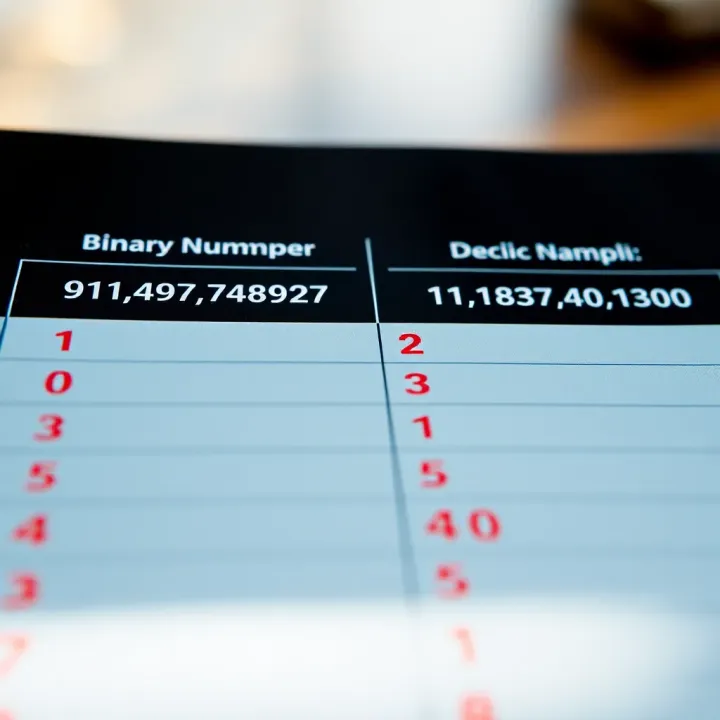
The decimal system uses base-10 with digits 0 to 9, familiar from everyday life and financial calculations. Binary, however, uses base-2 with just 0 and 1. This difference means that binary numbers are longer than their decimal counterparts but fit neatly with computer architecture. For example, decimal 25 is 11001 in binary. Recognising this helps finance professionals dealing with algorithmic trading or quantitative models, where data is often handled at a binary level before presentation.
Computers use binary because digital circuits are more reliable with just two states—high voltage (1) and low voltage (0). This reduces error chances compared to representing ten different states electrically. Also, binary simplifies processor design and increases noise immunity. Therefore, financial analysts working with complex software need to appreciate that all financial computations at hardware level rely on this binary logic, ensuring consistent and error-resistant processing.
Mastering the basics of binary numbers gives you a clearer view behind the scenes of computational finance tools, making complex data handling more transparent.
This knowledge benefits traders, investors, and financial analysts as they increasingly rely on algorithms and software that fundamentally run on binary data, bridging theory with application in the digital age.
Understanding how to convert between binary and decimal systems is critical for anyone dealing with finance technology, data analysis, or stock trading platforms that rely on digital computations. Binary numbers underpin all computer operations, so recognising how these translate to the decimal numbers we use every day helps you grasp what happens behind the scenes in trading apps or financial software.
Converting binary numbers to decimal involves interpreting each binary digit based on its position and corresponding power of two. This method is practical because it breaks down a string of 0s and 1s into a familiar number system, enabling analysts and traders to read outputs or logs that are stored in binary.
Here’s how the method works: start from the rightmost digit (least significant bit) and move left, multiplying each bit by 2 raised to the power of its position index, beginning with zero. Adding these values results in the decimal equivalent.
For example, consider the binary number 1011. Breaking it down:
1 × 2^3 = 8
0 × 2^2 = 0
1 × 2^1 = 2
1 × 2^0 = 1
Add them up (8 + 0 + 2 + 1), and you get 11 in decimal. This step-by-step calculation clarifies digital readings from financial software or even certain encryption mechanisms that rely on binary.
Converting decimal numbers into binary mostly involves the division-remainder method. This approach is straightforward and widely used, making it important for anyone wanting to understand how decimal inputs get processed in binary-based systems.
To apply this method, divide the decimal number repeatedly by 2, noting the remainder for each division. Collecting the remainders in reverse order gives the binary representation. This technique works well for coding stock values, transaction counts, or any numerical data that software systems must handle in binary format.
Take the decimal number 19 as an example:
19 ÷ 2 = 9 remainder 1
9 ÷ 2 = 4 remainder 1
4 ÷ 2 = 2 remainder 0
2 ÷ 2 = 1 remainder 0
1 ÷ 2 = 0 remainder 1
Reading remainders from bottom to top, 19 in decimal converts to 10011 in binary.
For larger numbers, such as 275, the same process applies, though with more steps. This method helps when working with data-heavy environments, like high-frequency trading systems or complex financial algorithms needing binary input.
Knowing how to switch between binary and decimal makes understanding data flows easier, whether you’re analysing backend data or overseeing digital processes in market analytics.
By mastering these conversions, financial analysts and traders can bridge the gap between raw digital data and meaningful numerical information, improving their grasp of modern finance tools.
Binary arithmetic operations form the backbone of processing in digital computers. Since computers use the binary number system internally, understanding how to perform arithmetic like addition, subtraction, multiplication, and division in binary is essential for grasping how calculations happen at a fundamental level. This section breaks down these operations and explains their practical importance.
Binary addition follows simple rules using only the digits 0 and 1. The basic principles are:
0 + 0 = 0
0 + 1 = 1
1 + 0 = 1
1 + 1 = 10 (which means 0, carry 1 to the next higher bit)
These rules mirror decimal addition but are limited to two digits only. Addition in binary is fundamental because all higher operations like multiplication derive from repeated additions. For example, when computers add two numbers, each bit pair is added following these rules, just like adding two decimal digits.
In binary, the carry-over mechanism works similarly to decimal addition. For instance, adding the binary numbers 1011 (11 decimal) and 1101 (13 decimal) involves carrying bits when two 1s are added:
1011
1101 11000
Starting from the rightmost bit:

- 1 + 1 = 10 (write 0, carry 1)
- Next bit: 1 + 1 + carry 1 = 11 (write 1, carry 1)
- Next bit: 0 + 1 + carry 1 = 10 (write 0, carry 1)
- Next bit: 1 + 1 + carry 1 = 11 (write 1, carry 1)

The carry at the highest bit becomes a new bit in the result. Carry handling is crucial since it ensures accurate results, especially in multi-bit binary operations used in computer processors.

### Subtraction in Binary

#### Binary subtraction basics
Binary subtraction works on similar principles to decimal subtraction but with only digits 0 and 1. The main rules are:

- 0 - 0 = 0
- 1 - 0 = 1
- 1 - 1 = 0
- 0 - 1 = 1 (borrow 1 from higher bit)

It is practically important because subtraction is a frequent operation in algorithms, including financial calculations and data processing.

#### Borrowing mechanism
When subtracting 1 from 0 in a bit position, binary subtraction requires borrowing from the next higher bit set to 1, similar to decimal borrowing. Consider subtracting 101 from 1100:
1100
0101 0111
Here, to subtract 1 from 0, the borrow travels from left bits, flipping bits on the way, which makes the calculation work correctly. This borrowing approach ensures binary subtraction can handle all cases, underpinning many computer arithmetic functions.

### Multiplication and Division

#### Binary multiplication method
Binary multiplication is like decimal multiplication but simpler, as it involves only 0s and 1s. The basic rule is:

- 0 multiplied by anything is 0
- 1 multiplied by anything is the number itself

Multiplication proceeds by adding shifted versions of the multiplicand depending on the multiplier bits. For example, multiplying binary 101 (5 decimal) by 11 (3 decimal) involves:

- Multiply 101 by 1 (LSB of multiplier) = 101
- Multiply 101 by 1 (next bit), shift left by one position = 1010
- Add these: 101 + 1010 = 1111 (15 decimal)

This method is directly implemented in computer hardware for fast calculations.

#### Binary division explained
Binary division mimics long division in decimals, where the divisor is compared with parts of the dividend starting from the most significant bits. It subtracts the divisor when possible and shifts bits accordingly.

For instance, dividing 1101 (13 decimal) by 10 (2 decimal):

- Check first two bits: 11 (3 decimal) is greater than 10 (2 decimal), so subtract and note down 1
- Bring down next bit, repeat until the entire dividend is processed

Binary division is important in processors for tasks like address calculation, algorithm implementations, and controlling loops. Despite being more complex than addition or subtraction, efficient binary division algorithms power many computing operations.

> Mastering binary arithmetic helps readers appreciate computing's inner workings, especially how machines handle data with 0s and 1s.

## Applications of the Binary Number System

The binary number system underpins many aspects of technology we use daily, particularly in digital computing and communications. Its applications extend beyond theory, affecting how data is stored, processed, and transmitted. Understanding these uses helps appreciate why binary remains indispensable, especially in environments demanding precision and reliability.

### Use in Digital Computers

**Binary data storage** forms the foundation of computer memory and storage devices. Every piece of data on your computer, from documents to videos, is stored as a series of 0s and 1s. This works because physical components like transistors switch on and off to represent these binary digits (bits). For example, a hard drive stores data by magnetising spots in one of two orientations corresponding to 0 or 1. This simplicity allows devices to store vast amounts of data reliably and read it quickly.

**Logic gates and circuits** use binary logic to perform computations. These tiny electronic components follow rules based on inputs of 0s and 1s to produce outputs that drive everything from basic arithmetic to complex algorithms. For instance, an AND gate outputs 1 only if both inputs are 1. This binary approach makes circuit design straightforward and error-resistant, which is critical in financial computing systems where accuracy in processing transactions or stock prices directly impacts decisions.

### Role in Communication Systems

**Encoding data for transmission** relies heavily on binary. Digital communication, including mobile networks and the internet, converts voice, text, and images into binary codes before sending them as signals. This encoding helps maintain integrity over long distances. One example is mobile texting, where each character is represented by a specific binary code, ensuring the message reaches the receiver correctly despite potential interference.

**Error detection and correction** are essential in communications to avoid data loss or corruption. Binary systems include checks like parity bits or more advanced algorithms like cyclic redundancy check (CRC) that detect errors in transmitted messages. If an error is found, correction methods either fix it automatically or request retransmission. This practice is particularly important in banking or stock trading where even minor data inaccuracies can cause large monetary losses or wrong trades.

> Digital finance and communication depend heavily on binary's ability to provide fast, reliable, and accurate data handling, making it the backbone of modern economic activities.

Together, these applications of the binary number system demonstrate why millions of rupees flow securely in Indian stock exchanges regulated by binary-based computing systems every day. Traders, investors, and analysts all rely on this invisible language to make well-informed decisions swiftly and effectively.Learn how to convert binary numbers to decimal step-by-step! 🧮 Understand number systems with examples, common mistakes, and practical uses in computing.

Learn how numbers work in binary code 💻 Explore binary basics, conversions to decimal, and their everyday uses in technology for better computing insights 🔢
Explore how the binary, decimal, octal & hexadecimal number systems work 🔢. Learn their bases, conversions, and roles in programming & digital tech 💻.

📊 Understand binary distribution in probability, exploring its maths, key properties, and real-world Indian examples for deeper statistical insight. 🇮🇳
Based on 11 reviews