
Understanding Maximum Depth of a Binary Tree
Explore how to find the maximum depth of a binary tree 🌲 in algorithms and applications, with clear examples ideal for students and developers.
Edited By
Oliver Bennett
Simply put, the maximum depth is the longest path from the tree’s root (the starting node) to any leaf node (the end point), and it plays a big role in how quickly you can access or retrieve data.
For those navigating financial models or stock trading algorithms, grasping this concept is important because it underpins the performance of various data structures used in their tools. From recursive techniques to iterative methods, and even practical coding tips—this article will take you through all that without leaving you in the weeds.

Knowing the depth helps in balancing binary trees which directly affects how fast your queries run.
In the sections ahead, we’ll cover what maximum depth actually means, how you can find it, mistakes to watch out for, and how it links to related ideas like tree height and balanced trees. By the end, you’ll be ready to implement these concepts in your own data structure challenges, making your financial applications faster and more reliable.
Before diving into the maximum depth of a binary tree, it's essential to get a grip on the basics. Binary trees lay the groundwork for numerous applications in computing, especially when dealing with hierarchical data or performing efficient searches and sorts. Understanding their fundamental structure helps in grasping why depth matters and how it influences the tree's behavior in real-world scenarios.
A binary tree consists of nodes, each typically containing three parts: data, a left child pointer, and a right child pointer. This simple structure allows each node to branch into at most two children, which is what defines a binary tree as opposed to other tree types. Think of it like a family tree where every person can only have up to two children.
This clear-cut branching makes traversing and managing data more straightforward. For example, in financial software, transactions might be stored in such trees to allow fast lookups or insertions. Each node acts like a folder holding key info and links pointing to ‘subfolders’ (left and right children).
Binary trees come in a few flavors, each with properties that affect performance and usability:
Full Binary Tree: Every node has 0 or 2 children. This consistency can make depth calculations predictable.
Complete Binary Tree: All levels are fully filled except possibly the last, which is filled from left to right. This structure favours balance, which often means shallower depth.
Balanced Binary Tree: The heights of the left and right subtrees of any node differ by no more than one. This is crucial for keeping operations like search and insert efficient.
Degenerate (or skewed) Tree: Each parent node has only one child, resulting in a structure resembling a linked list with maximum depth equals the number of nodes.
Knowing these types helps when you're evaluating trees from data or designing one for specific tasks—like maintaining a sorted list with minimal lookup times.
These terms often get mixed up but they have distinct meanings:
Depth: How far a node is from the root. The root node’s depth is 0, its children have depth 1, and so on.
Height: The height of a node is the length of the longest path from that node down to a leaf. The height of the tree itself is the height of the root.
Level: Level numbers usually start at 1 for the root and increase by 1 down each layer.
For example, in a trading algorithm that uses a binary tree to track decision nodes, the maximum depth represents how many steps (decisions) it takes to reach the farthest end (leaf). Mixing these up can throw off performance tuning or cause inefficient coding.
Depth isn't just a number; it directly impacts how efficient your tree operations are. The deeper the tree, the longer it can take to traverse or search, kind of like finding a file nested deep within folders. For financial databases handling tons of transaction records, if the tree gets too deep, queries might slow down noticeably.
Manipulating or analyzing financial data using trees benefits from shallow depth because it leads to faster data retrievals and less computational overhead. Algorithms that balance the tree to ensure minimum depth improve response times and reduce memory use.
A well-balanced binary tree with smaller maximum depth is like a neatly organized office—finding what you need takes a fraction of the time compared to a messy one.
Take, for example, a stock market analysis tool that uses binary trees to organize and retrieve vast amounts of trading data. The depth tells you how many decisions or comparisons you might undergo before hitting the piece of data you're after. Knowing this helps in optimizing preparations and expectations regarding system performance.
The maximum depth is simply the count of nodes along the longest path from the tree’s starting point — the root — to the farthest leaf node. Unlike the average depth, which might reflect typical scenarios, the maximum depth points out the worst-case traversal length. This way, it becomes instrumental in anticipating how your operations might stretch out in time or complexity.
For instance, if a binary tree represents decision routes in an investment algorithm, maximum depth shows the longest chain of choices before reaching a final verdict. The deeper it is, the more recursive calls or iterations you might expect during calculations.
Visualizing maximum depth helps grasp the concept more tangibly. Picture a family tree: the height of the tallest branch from the great-grandparent to the most distant cousin defines that family's maximum depth. In binary trees, this translates to the path that involves the greatest number of edges connecting nodes from root to leaf.
One practical approach is to sketch the tree and mark distances or count levels from the root downward. This physical representation is especially handy when you’re debugging or optimizing software involving complex data hierarchies.
The maximum depth directly influences how tree traversals occur. Operations like searching or inserting nodes involve moving down paths that may, in the worst case, extend to the maximum depth. The longer this path, the more computational steps you need, which can slow things down if not properly managed.
In real-world terms, if you're designing a financial application with binary trees to sort transaction records or queries, understanding the maximum depth helps you estimate the time your system might consume during peak loads or complex queries.
Tree performance ties closely with its maximum depth. Deeper trees might lead to higher response times and memory consumption, especially for recursive functions managing the tree. On the flip side, trees balanced to keep their depth minimal can provide faster operations and save resources.
For example, balanced binary search trees like AVL or Red-Black trees maintain a low maximum depth to ensure operations complete in logarithmic time, which is crucial for high-frequency trading applications where milliseconds matter.
Knowing the maximum depth isn’t just academic—it’s the first step in optimizing tree-based data systems to be faster and more reliable.
In summary, the maximum depth of a binary tree is a fundamental concept with real implications in programming and software design. Being able to define, visualize, and measure this depth equips developers and analysts with the tools needed to fine-tune applications handling complex, hierarchical data.
Calculating the maximum depth of a binary tree is fundamental for many applications, especially when dealing with hierarchical data like decision trees or portfolio structures. Knowing how deep a tree goes helps in optimizing search operations and resource allocation. In practice, software developers and analysts often rely on two main methods: recursive and iterative approaches. Both have their pros and cons, depending on the problem’s constraints and the size of the tree.
The recursive technique is straightforward and intuitive. It works by diving into each subtree, computing their depths separately, and then returning the greater depth plus one for the current node. Essentially, it breaks down the problem into smaller chunks – much like solving a puzzle by focusing on each piece before looking at the whole.
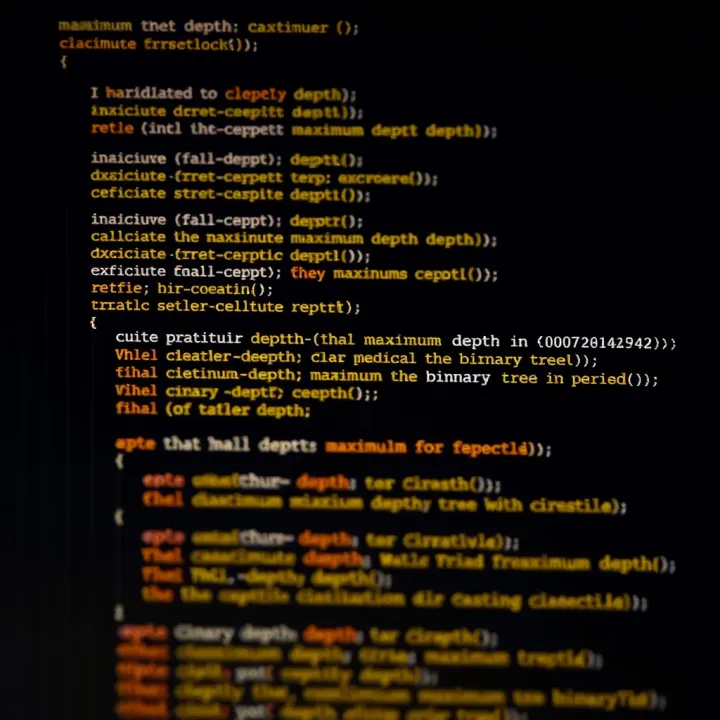
python def max_depth(node): if not node: return 0 left_depth = max_depth(node.left) right_depth = max_depth(node.right) return max(left_depth, right_depth) + 1
This simple snippet captures the essence: if the node is null, depth is zero; otherwise, it recursively checks both left and right branches. The recursive call stack keeps track of current progress.

**Time and space complexity considerations** come into play mainly with very large or skewed trees. Time complexity here is O(n), where n is the number of nodes, because each node is visited once. Space complexity, however, depends on the height of the tree: O(h) for the call stack in the worst case (a skewed tree behaving like a linked list), which could lead to stack overflow if the tree is super deep without tail-call optimization. For balanced trees, the space complexity improves to O(log n), making it viable for most moderate-sized data sets.

### Iterative Approach Using Queues

The iterative method often uses level order traversal, which processes nodes level by level using a queue. Instead of diving deep into one side first, this breadth-first approach captures the tree’s depth by counting how many "layers" you peel off.

A typical method starts by placing the root into a queue. Then, it loops until the queue is empty, processing all nodes at the current level before moving on to the next. This way, each iteration represents a new depth level.

```python
from collections import deque

def max_depth_iterative(root):
    if not root:
        return 0
    queue = deque([root])
    depth = 0
    while queue:
        level_size = len(queue)
        for _ in range(level_size):
            node = queue.popleft()
            if node.left:
                queue.append(node.left)
            if node.right:
                queue.append(node.right)
        depth += 1
    return depth
This approach is particularly helpful when dealing with extremely deep trees, as it avoids recursion limits and stack overflow issues.
Handling edge cases here means considering situations like an empty tree (return zero), a tree with only one node (depth is one), or heavily unbalanced trees where one branch is much deeper. The iterative method gracefully handles all without extra checks, but you should always verify that your queue is correctly initialized and emptied to prevent infinite loops.
Choosing between recursive or iterative approaches depends on your specific needs. Recursive is elegant and easy to implement but may fail for very deep trees. Iterative is more robust for large or skewed inputs, though slightly more complex to code.
To sum up, mastering these methods puts you ahead when analyzing binary trees, whether for designing algorithms or making smart decisions around data structure efficiency.
Practical examples bring theory to life, and this is especially true when trying to grasp the maximum depth of a binary tree. While the concept might seem straightforward — finding the longest path from root to leaf — actually coding the solution forces you to understand it at each step. Coding examples let you see how the calculation pans out, what pitfalls could arise, and which approaches might work best for your specific case.
For financial analysts or traders who dabble in algorithmic trading systems relying on tree-based data structures, these examples demonstrate real-world usage. For instance, an unbalanced tree might reflect an imbalanced portfolio structure, and knowing its depth can guide efficiency in data retrieval or decision-making processes. Whether you choose a recursive method or an iterative one using queues, these code samples clarify those strategies.
Let's say you have a binary tree representing some nested decision points in a trading algorithm. The Python example breaks down the maximum depth calculation into bite-sized chunks. Starting from the root node, the algorithm checks if the node is null — if yes, it returns zero, signaling no depth here. If not, it recursively calls itself for the left and right subtrees.
By comparing the depth returned from both subtrees and adding 1 (for the current node), you get the depth at that point. This process repeats down the whole tree, bubbling up the maximum depth found. This recursive method is simple to read and write, making it ideal for quick prototyping.
python class TreeNode: def init(self, val=0, left=None, right=None): self.val = val self.left = left self.right = right
def maxDepth(root): if not root: return 0 left_depth = maxDepth(root.left) right_depth = maxDepth(root.right) return max(left_depth, right_depth) + 1
#### Optimizations and variations

While the recursive approach is elegant, it can strain the call stack for very deep trees, risking a stack overflow. Tail recursion optimization is not supported natively in Python, so iterative solutions sometimes become necessary.

One way to optimize is to switch to a breadth-first search (BFS) style level order traversal using a queue, which calculates depth without deep recursion. Alternatively, memoizing previously computed depths in a more complex tree (for example, with redundant subtrees) can save repeated work. Also, if you're certain your tree is balanced, some shortcuts can reduce unnecessary checks.

Changing the function slightly to handle asynchronous calls or parallel depth evaluations might help when running in more complex real-time systems like stock trading platforms.

### Example in Java

#### Code implementation details

Java’s strict typing helps catch errors early, especially in larger software where trees represent various hierarchical data like investment portfolios or decision trees for risk assessment. The Java example follows the recursive principle but using classes and method calls familiar to Java developers.

It clearly defines the TreeNode class with left and right references. The maxDepth method similarly checks for null nodes (base case) and recursively finds left and right depths to find the max.

```java
public class TreeNode
    int val;
    TreeNode left, right;

    TreeNode(int val)
        this.val = val;
        left = right = null;

public int maxDepth(TreeNode root)
    if (root == null) return 0;
    int leftDepth = maxDepth(root.left);
    int rightDepth = maxDepth(root.right);
return Math.max(leftDepth, rightDepth) + 1;When coding in Java, it pays to keep a clean, readable structure. Using clear method names and avoiding nested conditional statements makes debugging easier, especially if the tree gets large. Avoid unnecessary object creation inside recursive calls to reduce heap space waste.
One clever trick is to handle null checks upfront, which prevents deeper nested code. Also, testing your maxDepth method with edge cases like empty trees, one-sided trees (left-only or right-only), or very deep trees helps ensure robustness.
If working on performance-critical applications like real-time risk analysis in financial systems, consider iterative solutions or hybrid methods that combine recursion with data structures like stacks to avoid deep recursion pitfalls.
Understanding these coding examples in both Python and Java not only sharpens your grasp of binary trees but prepares you to implement these solutions effectively in the financial software that demands both accuracy and efficiency.
Understanding and calculating the maximum depth of a binary tree might sound straightforward, but it's easy to trip over subtle pitfalls that can lead to incorrect results or inefficient code. For traders, investors, financial analysts, and students dealing with algorithmic problems, being aware of common challenges ensures precision and saves valuable debugging time. Addressing these mistakes early on can improve both your coding practices and how effectively you apply these concepts in financial modeling or data structuring.
One of the most frequent mix-ups is treating the maximum depth of a binary tree as the number of nodes within it. Maximum depth refers specifically to the longest path from the root node down to the furthest leaf node — basically, the height of the tree — not the total nodes you find along the way or in the tree overall. For instance, a tree might have 15 nodes but a maximum depth of only 4. Confusing these can lead to misinterpretations, like overestimating traversal times or misjudging memory requirements, which matter when you deal with extensive datasets or complex hierarchical structures in financial simulations.
To avoid this, always clarify whether you’re measuring depth or size. In coding terms, maximum depth is a measure of tree levels, while node count is about the number of individual elements.
The base case in recursive functions calculating maximum depth is crucial to stop the recursion correctly. A common error is not handling the base case where the node is null properly, causing functions to continue unnecessarily or break abruptly. This mistake leads to wrong depth calculations or even runtime errors.
In practice, when recursively checking nodes, your base case should return 0 or a similar value when encountering a null (absent) child node. This ensures the recursion rolls back as intended, and the max depth reflects the actual tree structure. Neglecting this detail can cause a tree traversal to overshoot or produce inaccurate depth counts, impacting downstream processes that depend heavily on the tree’s accurate height.
Recursive methods are elegant but can be costly if poorly managed. Repeatedly calling depth calculations on subtrees without storing intermediate results can slow down your program considerably, especially with large trees typical in complex computational finance models or trade data hierarchies. Every recursive call consumes stack memory and adds overhead, making inefficiency climb quickly.
An effective approach is to make sure each node is visited only once, returning the pre-calculated depth of its children nodes. Memoization or iterative methods sometimes replace recursion where scale becomes an issue. Avoiding redundant calls helps maintain efficiency, preventing code from getting bogged down, particularly in performance-sensitive applications like real-time trading platforms.
Deep trees can cause your recursive algorithm to hit stack overflow errors, crashing or freezing your program. This problem occurs because each recursive call adds a new frame to the call stack, and with very tall trees — common in large datasets or poorly balanced financial data trees — the stack can get overwhelmed.
To mitigate this, you might:
Limit tree depth if possible through data pruning or restructuring
Switch to iterative depth-first or breadth-first approaches using explicit stacks or queues
Use tail recursion optimizations or languages that better support deep recursion
These strategies prevent your app or analysis tool from throwing errors during heavy processing, maintaining reliability and robustness when working with massive or intricate binary trees.
The key to mastering maximum depth calculation lies not just in knowing what it means, but also knowing what trips you up along the way. Taking care with base cases, avoiding confusion with node counts, and being mindful of recursive limitations can make your code both accurate and practical.
Understanding other tree types and structures is key when studying maximum depth in binary trees. Different tree forms, like balanced trees or full trees, impact the depth differently, affecting performance and algorithm choices. Grasping these distinctions can save time and prevent misinterpretation when analyzing tree-based data models.
Balanced trees aim to keep their depth as small as possible, which improves efficiency for operations like searching or inserting nodes. For example, in a perfectly balanced binary tree, the maximum depth is approximately ( \log_2(n) ), where ( n ) is the number of nodes. On the contrary, unbalanced trees can have depths close to the number of nodes, essentially becoming like linked lists. This deepening causes slowdowns in traversals or searches because the maximum depth directly impacts how many steps are needed.
A practical takeaway is that balanced trees maintain shallow depths, which speeds up data operations, while unbalanced trees potentially lead to performance bottlenecks.
Take an AVL tree and a skewed binary tree. AVL trees rotate nodes as needed to stay balanced, resulting in depths much smaller than the total count of nodes — usually around ( \log_2(n) ). In contrast, a left-skewed binary tree, where each node only has a left child, can have a maximum depth equal to ( n ), turning searches into a lengthy walk down one branch.
| Tree Type | Expected Maximum Depth | Performance Consideration | | Balanced (AVL) | ( O(\log n) ) | Faster searches and inserts | | Unbalanced (Skewed)| ( O(n) ) | Slow operations, deeper stacks |
Knowing these differences helps you choose a tree type that fits your application's needs, especially when depth affects speed.
Complete and full binary trees follow stricter node placement rules, which influence their maximum depth predictably. A complete binary tree fills every level except possibly the last, which is filled from left to right. This guarantees that the tree’s depth is as small as possible for the number of nodes.
A full binary tree, meanwhile, is one where every node has either zero or two children—never one. This limitation means the tree is well-structured, but the maximum depth can vary depending on how many such nodes exist.
For example, a complete binary tree with 15 nodes will have a maximum depth of 4 (levels 0 to 3), because ( 2^4 - 1 = 15 ). This predictability makes calculations straightforward. In contrast, depth in full trees depends heavily on arrangement but generally remains balanced enough to avoid worst-case depths.
When calculating depth, knowing if the tree is complete or full helps anticipate the minimum and maximum possible depths, aiding in algorithm design and performance tuning.
Studying these related concepts provides a clearer picture of how maximum depth behaves in different scenarios. For investors and financial analysts who build or use decision trees or search trees in risk modeling or algorithmic trading systems, understanding these subtleties can improve both model accuracy and computational speed.
The maximum depth of a binary tree directly influences how fast you can find a specific item in the structure. Think of it like a phone book: the deeper the index goes, the longer it might take to flip through pages. In binary trees used for searching, the depth represents the longest path from the root node to a leaf. The deeper this path, the more comparisons or steps are needed to locate an item. For financial analysts running queries on market data, every extra step adds latency that can slow down decision making.
Reducing tree depth means fewer checks per query, which can speed up searches significantly. Balanced trees like AVL or Red-Black trees maintain a lower maximum depth automatically, helping keep search operations snappy. For instance, a balanced binary search tree with a depth of 10 will generally perform faster lookups than an unbalanced one with depth stretching into 20s, which could delay crucial trades.
Binary search trees (BSTs) are a natural fit to discuss here since their structure depends heavily on depth for efficient operation. Each node in a BST has a key value, with left children smaller and right children larger. Searching works by traversing this tree based on comparisons, so the maximum depth determines the worst-case path length.
If you're building or maintaining a BST for a financial database—say, tracking stock tickers or transaction records—keeping the tree from growing too deep matters. An unbalanced BST that leans heavily to one side can degrade to a linked list, making search operations painfully slow. Algorithms to keep BSTs balanced help maintain a practical maximum depth, preserving quick access times that traders or financial analysts need for up-to-date info.
The deeper your binary tree goes, the more memory and processing resources it requires, especially when performing recursive operations or traversals. Practically speaking, if you’re managing large datasets such as historical stock prices stored in a binary tree, deeper trees mean higher memory consumption and potentially more CPU cycles spent navigating.
For example, deep recursive calls to calculate depth or perform searches risk stack overflow issues in systems with limited stack memory. In applications focused on real-time trading or stock analysis, where performance is time-sensitive, paying attention to tree depth helps avoid such pitfalls.
Efficient resource allocation involves managing depth so you don’t overly burden the system. This might mean balancing the tree regularly or limiting depth during progressive data insertions. In financial platforms processing huge volumes of data, this approach helps keep resource use predictable and ensures the system remains responsive.
The key takeaway here is that the maximum depth affects not just speed but also how resources—memory, CPU time—are consumed during data operations. Ignoring it can lead to slowdowns or crashes that are costly in time-critical trading environments.
In summary, understanding and managing the maximum depth of binary trees helps optimize search operations for faster decisions and manages system resources efficiently, both vital in financial and trading systems.
When you’ve already got a handle on the basics of maximum depth in binary trees, diving into more advanced topics sharpens your understanding even further. These subjects aren’t just academic; they can seriously impact how efficiently data structures perform in real-world apps, especially in finance and trading platforms where speed and accuracy are king. Exploring concepts like height-balanced trees and algorithmic improvements not only helps prevent performance bottlenecks but also equips you with know-how to optimize complex tree operations.
AVL and Red-Black trees are go-to examples of height-balanced binary trees designed to keep the tree’s depth in check. Why does that matter? Because a balanced tree keeps operations like search, insert, and delete running swiftly — often in logarithmic time. AVL trees maintain balance strictly by ensuring the heights of left and right subtrees differ by at most one. Red-Black trees, on the other hand, allow a bit more flexibility but enforce color-coding rules and properties that keep the tree roughly balanced.
For instance, in a trading system managing live order books, AVL trees can guarantee quick lookups even when orders rapidly change. Likewise, Red-Black trees, due to their less rigid balancing, often offer better performance in insert-heavy operations, making them practical for financial data feeds where rapid updates are routine.
Balanced depth prevents your tree from turning into something more like a linked list — which can slow down your processes dramatically. Not all binary trees are balanced by default; random insertions can skew depth. Strategies like rotations (in AVL and Red-Black trees) rebalance the tree immediately after insertions or deletions, honing the maximum depth to stay near the optimal range.
Maintaining this balance is crucial in applications where you can’t afford lag, such as real-time financial analysis tools. A tree that grows too deep may lead to longer search times, affecting algorithmic trading decisions or delayed risk assessment reports.
Recursive methods to find a tree's maximum depth are straightforward but can hit limits when trees get deep, causing stack overflow errors in some programming languages. Tail recursion, where the recursive call is the last action in a function, can be optimized by compilers into loops, reducing stack usage.
Better yet, converting recursive depth calculations into iterative versions using explicit stacks sidesteps recursion limitations altogether. For example, in Python or Java, replacing recursive calls with while loops and manual stack management keeps your algorithms running smoother and safer, especially when handling enormous tree data structures common in market data analysis.
With modern multi-core processors, running depth calculations in parallel can shave off precious milliseconds. By splitting the tree into subtrees and processing their depths concurrently, you can reduce total computation time significantly. This approach requires careful handling to avoid race conditions but pays off in environments like high-frequency trading, where milliseconds matter.
Imagine a financial simulation running on Amazon’s AWS Graviton processors — employing parallel algorithms for depth calculation can enhance responsiveness dramatically. Such improvements translate to faster analytics and quicker decision making.
Tackling advanced topics like balanced trees and algorithmic tweaks helps you not just understand the maximum depth theoretically, but also optimizes tree operations for real-world performance — a valuable asset in fast-moving financial arenas.
Explore how to find the maximum depth of a binary tree 🌲 in algorithms and applications, with clear examples ideal for students and developers.

Explore what maximum depth means in binary trees 🌳, learn recursive & iterative ways to find it, plus insights on balanced trees & algorithm complexity.
Learn how to find the maximum depth of a binary tree 🌳 using clear methods like recursion and iteration. Perfect for programmers and CS enthusiasts! 💻📚

Explore how to find the maximum height of a binary tree 🌳, understand its impact on data structures, and learn key calculation methods and algorithms 📊.
Based on 13 reviews