
Understanding Number Systems: Binary, Decimal & More
Explore how the binary, decimal, octal & hexadecimal number systems work 🔢. Learn their bases, conversions, and roles in programming & digital tech 💻.
Edited By
Emily Foster
Number systems form the basis of how we express and process numbers across various fields, especially computing and finance. Most of us are familiar with the decimal system, which uses ten digits (0 to 9), but behind the scenes, computers depend on other number systems to manage data efficiently.
In this article, we'll look at four key number systems: binary, octal, decimal, and hexadecimal. Each system uses a different base, which determines the number of unique digits it employs. For instance:
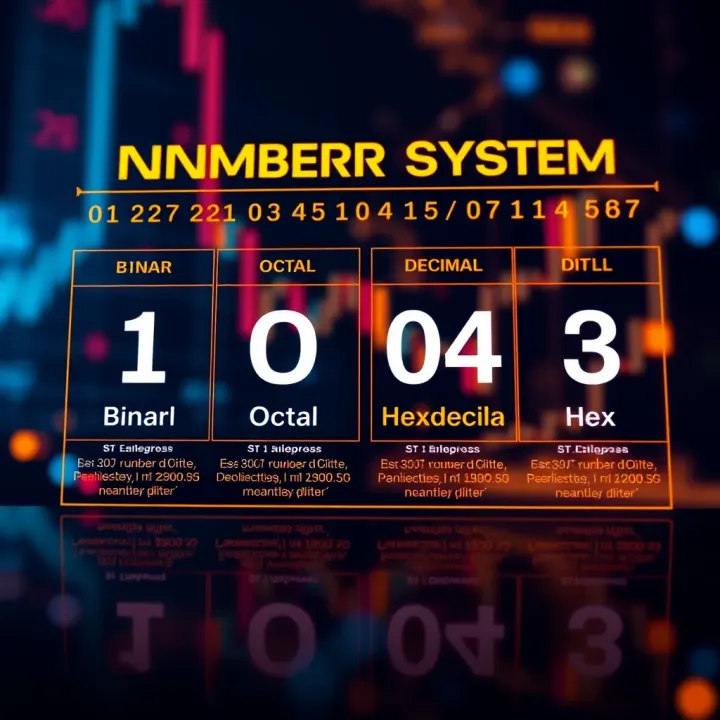
Binary is base 2 and uses two digits (0 and 1).
Octal is base 8, using digits 0 to 7.
Decimal is base 10, the system we use daily.
Hexadecimal is base 16, employing digits 0 to 9 plus letters A to F.
These systems aren’t arbitrary; they serve practical roles in computing and digital electronics. For example, binary reflects the on/off state in electronic circuits, while hexadecimal offers a compact way to represent large binary values.
Understanding how these number systems work—and how to convert between them—is key not only to computer science but also to financial analysts and traders working with complex data and algorithms.
The following sections will explain how each number system functions, the significance of their bases, and practical examples relevant to your field. We will also cover conversion techniques to help you switch between these systems confidently.
This knowledge will clarify why multiple number systems exist, how they contribute to efficient computing, and their growing importance in analytics, algorithmic trading, and digital finance both in India and worldwide.
Number systems form the backbone of how we represent and work with numbers. Whether you're analysing stock data, programming trading algorithms, or studying financial patterns, understanding these systems is essential. Different number systems help us interact with technology and data efficiently, especially since computers operate differently from humans.
A number system is a method for writing numbers using a consistent set of symbols and rules. For example, the decimal system uses digits from 0 to 9 to write any number. This system is familiar because we use it daily to count money, measure quantities, and record dates.
Different number systems provide alternative ways of expressing numbers based on their 'base' or radix. Each base determines how many unique digits it uses before cycling to a new place value, which is crucial for computing and data representation.
But why do different bases exist? Simply put, they exist because certain bases are more practical for specific applications. Humans find base 10 (decimal) natural due to having ten fingers, but computers use base 2 (binary) since electronic circuits have two states—on and off.
Using bases like octal (base 8) or hexadecimal (base 16) helps bridge human-readable numbers and the binary world inside digital devices. These systems offer shortcuts for representing long strings of binary data more compactly.
The four most common number systems you'll encounter are binary, octal, decimal, and hexadecimal.
Binary (base 2) uses only 0 and 1; it's the language of computers.
Octal (base 8) uses digits 0 to 7 and is sometimes used in computing as a shorthand for binary.
Decimal (base 10) is the everyday system using 0 to 9.
Hexadecimal (base 16) extends digits to include 0–9 and letters A–F, simplifying the representation of large binary numbers.
Each of these systems plays a role in technology and daily life. For example, a stock market software may display prices in decimal, but under the hood, data is processed in binary or hexadecimal formats to optimise efficiency.
Understanding these number systems can improve your grasp on how digital financial platforms function and help when interpreting data formats or debugging algorithm output.
Number systems are not just abstract concepts but practical tools. Traders analysing algorithmic trades, investors scrutinising data feeds, and analysts developing financial models all benefit from knowing how these systems work. It helps ensure better communication between human-readable information and machine-level processing, for accuracy and speed.
Having this foundation sets the stage for exploring each system in depth, their applications in finance and technology, and how you can convert numbers between them.
The decimal number system forms the backbone of everyday calculations and finance, especially in India. Its base is ten, which means it relies on ten distinct digits: from 0 through 9. This particular base makes counting and arithmetic intuitive since we have ten fingers to count on. This natural alignment between our physical experience and the system itself is a big reason why decimal dominates arithmetic in daily life and financial transactions.
In practical terms, the base 10 system assigns place values based on powers of ten. For example, the number 4,367 represents 4 thousands (4 x 10³), 3 hundreds (3 x 10²), 6 tens (6 x 10¹), and 7 units (7 x 10⁰). This place-value system allows for efficient representation of even large numbers. For traders and financial analysts, the ability to quickly interpret and manipulate values expressed in decimal is crucial—whether analysing stock prices, calculating profit margins, or working with currency figures.
The decimal system uses ten as its base. This means each position in a number represents a power of 10. Starting from the right, places are ones, tens, hundreds, thousands, and so forth. The ease of grouping by tens is highly practical—especially in markets like India, where prices and quantities commonly use this base. Unlike binary or hexadecimal, which suit computing needs, decimal fits human-centric activities involving counting and commerce best.
Digits range from 0 to 9, providing the symbols needed to express any number through combination. For instance, the digit “5” in the hundreds place of 5,432 actually stands for 500. This place value principle enables compact notation and simplifies calculations for invoices, budgets, stock counts, or daily expenses. For someone dealing with complex portfolios or trading numbers, understanding how digits represent quantities at different scales adds accuracy when interpreting data.
Across India, the decimal system is the foundation of all monetary values, measurements, and most numerical data. Whether it is the rupees spent at a local market or the lakh crore figures in government budgets, decimal reigns supreme. Even GST on bills, P/E ratios in the stock market, or commodity weights are represented in decimal. Its universal adoption makes financial analysis, tax calculations, and business decisions reliable and consistent.
The decimal system is an ancient concept with roots in Indian mathematics. Indians developed the place-value system and zero concept centuries ago, which later spread globally via Arab traders. This innovation made arithmetic and algebra more manageable compared to older systems like Roman numerals. Recognising the decimal system’s historical significance helps appreciate its dominance today. This legacy also emphasises India’s contribution to modern mathematics, further underscoring decimal’s central role in finance and technology.
Understanding the decimal system is essential for anyone in finance, as this base aligns perfectly with how we measure money, goods, and value daily. Grasping its structure improves numerical literacy and financial decision-making significantly.
Key points:
Decimal is base 10, relying on digits 0–9.
Each digit’s value depends on its place (units, tens, hundreds, etc.).
This system suits human-centric counting and commerce.
It underpins all financial data in India, from rupees to stock values.
India played a pioneering role in developing the decimal system historically.
For a trader or analyst, mastering decimal numbers is not just academic—it dictates the precision and clarity of everyday financial tasks.
The binary number system uses base 2, which means it has only two digits: 0 and 1. This simplicity is the main reason binary forms the foundation of all modern digital systems. Unlike the decimal system that uses ten digits, the binary’s two-digit setup aligns perfectly with physical devices that have two states, such as ON/OFF or TRUE/FALSE. This practical aspect makes binary the natural fit for digital electronic circuits.
Understanding why base 2 matters comes down to its reliability and ease of implementation in hardware. Imagine a computer's memory storing data as a series of tiny switches; these switches either conduct electricity or not, representing 1 or 0 respectively. Managing thousands or millions of such switches becomes manageable because the system only needs to differentiate between two states rather than multiple ones.
The digits 0 and 1 represent two distinct states that devices like transistors or logic gates can easily handle. This contrasts with trying to represent more digits, which would require multiple voltage levels, increasing complexity and the chance of errors. The binary digits are thus not just abstract numbers but reflect physical realities in computing hardware, allowing fast, accurate processing of data.
Binary is the backbone of computing and digital electronics. All computer processors operate by manipulating sequences of 0s and 1s which represent instructions, numbers, or characters. When you open an app on your mobile or tweak data in a spreadsheet, the underlying operations happen in binary. This system also powers everything from smartphones to ATMs, making it a key part of India's growing digital economy.
The close connection between binary and electronic logic is crucial for designing digital circuits. Logic gates interpret binary inputs and perform basic operations like AND, OR, and NOT, which combine to execute complex functions. For example, a simple binary addition in an electronic calculator relies on these gates. This method of using 0s and 1s turns abstract commands into physical actions, enabling everything from data processing in financial trading algorithms to encryption in online banking.
Binary coding simplifies hardware design by using straightforward two-state signals, ensuring reliability and speed in digital operations.
In finance, binary logic helps secure transactions and process large volumes of data swiftly. Financial analysts use software built on binary systems to analyse market trends, execute trades, and manage risk. Thus, understanding binary is not just academic; it is practical, impacting everyday life and the technology behind it.
Binary uses only two digits (0 and 1), matching physical on/off states.
This makes digital hardware simpler, faster, and less error-prone.
All modern computing devices, from laptops to mobile wallets, rely on binary.
Logic gates process binary inputs to perform basic and complex calculations.
Binary systems underpin technologies used in finance, education, and communication.
This understanding helps you appreciate why binary remains indispensable in technology and finance sectors across India and globally.
The octal number system uses base 8, meaning it relies on eight digits, from 0 to 7. This system is especially useful when dealing with binary numbers because each octal digit represents exactly three binary digits (bits). So, octal provides a simpler way to read and write binary data without recording long strings of 0s and 1s. This quality made octal practical in early computing, where binary was common but difficult to interpret directly.
In the octal system, place value increases by powers of 8 from right to left. For instance, in the octal number 345, the '5' represents 5×8⁰, the '4' represents 4×8¹, and the '3' represents 3×8². This system simplifies calculations in contexts where binary data is regularly handled, such as microprocessor design. Its structure closely aligns with digital hardware's binary signals, thus facilitating easier conversions.
Base 8 means counting up to seven before adding a new digit, unlike the decimal system, which counts up to nine. This smaller base can condense lengthy binary sequences. For example, the binary number 111010 converts to the octal number 72, which is easier to read and remember. This practical relation to binary makes octal especially helpful in certain technical fields.
Octal digits range from 0 to 7. Each position represents a power of 8, similar to how the decimal system works with powers of 10. For instance, the octal number 157 translates to decimal as (1×8²) + (5×8¹) + (7×8⁰) = 64 + 40 + 7 = 111. Understanding place values is essential for converting octal numbers accurately and applying them in computing tasks.
In early computers, machine architecture often worked with groups of three bits. Octal, grouping three bits per digit, offered a human-friendly shorthand for programmers and engineers. Systems like the PDP-8 used octal heavily because working directly with binary was error-prone and tedious. This convenience meant octal was the preferred numbering system before hexadecimal gained broader acceptance.
Though the hexadecimal system has largely replaced octal in modern computing, octal still finds use in specific scenarios. Unix and Linux file permissions are expressed in octal, where each digit represents read, write, and execute rights. For example, permission 755 in octal indicates specific access settings for owners and users. This real-world application proves octal is not just historical but still relevant today.
Understanding octal helps decode legacy systems and grasp certain computing concepts like permissions and machine code, giving finance professionals an edge when dealing with tech-oriented data or cybersecurity matters.
In summary, octal simplifies binary representation and maintains niche roles in modern computing, especially in permission management and embedded systems. Its close relation to binary makes it a valuable skill for anyone navigating the technical side of finance and IT.
The hexadecimal system plays a significant role in computing due to its efficiency and ease of use, especially when dealing with large binary numbers. It is a base-16 system that condenses binary data into a more readable and manageable form, which is crucial for programmers, analysts, and anyone working with digital technology.
Hexadecimal uses sixteen distinct digits, ranging from 0 to 9 and then A to F. The digits A, B, C, D, E, and F correspond to decimal values 10 through 15, respectively. This extended range allows the system to represent large numbers more compactly. For example, the decimal number 255 translates to FF in hexadecimal, which takes just two digits versus eight bits in binary.
Each digit in a hexadecimal number has a place value based on powers of 16. Just as in decimal, where the rightmost digit represents units (16^0), the next digit to the left represents 16^1 (or 16), then 16^2 (256), and so on. This positional value means that a hex number like 2F3 represents (2×16²) + (15×16¹) + (3×16⁰), or 755 in decimal.
Understanding place values in hexadecimal makes conversions and calculations straightforward, which is why this system is heavily favoured in technical fields.
Hexadecimal provides a compact and convenient way to represent binary data. For example, a single hexadecimal digit corresponds to exactly four binary digits (bits). This direct correlation means you can rewrite a binary number into a much shorter hexadecimal form without losing information. In computing, this simplification is invaluable, particularly when dealing with large data sets or memory addresses.
In programming, hexadecimal numbers are everywhere. Memory address locations are commonly displayed in hex, making it easier to understand and debug code. For instance, instead of writing a 32-bit address as a 0s and 1s string, programmers use an eight-digit hexadecimal number. Languages like C and Java allow hexadecimal representation directly in code, which helps in setting colours in graphics, encoding data, or working with low-level hardware instructions.
Hex also plays a crucial role in areas like digital wallets, security, and data encryption. For example, cryptographic hash codes, often used in digital transactions including those on UPI or other Indian digital payment platforms, are displayed in hexadecimal form for their compactness and readability.
In summary, knowing how the hexadecimal system works and where it fits helps traders, investors, and analysts understand the technology behind financial software, blockchain, and other digital tools they use daily. It also lays the foundation for interpreting machine-level data, enhancing your grasp of modern computing applications.
Converting numbers from one system to another is a practical skill, especially in finance, computing, and data analysis. Each number system has its unique base and representation, making conversion crucial for interpreting values correctly across various platforms. For traders and analysts, understanding these conversions aids in grasping how binary-coded data or hexadecimal addresses relate back to everyday decimal figures.
Converting binary to decimal and vice versa is the foundation of digital data comprehension. Convert binary to decimal by multiplying each binary digit by 2 raised to the power of its position index, starting from zero on the right. For example, the binary number 1011 equals 1×2³ + 0×2² + 1×2¹ + 1×2⁰ = 8 + 0 + 2 + 1 = 11 in decimal. Reversing this, convert decimal to binary by dividing the decimal number repeatedly by 2 and recording remainders until zero is reached. This conversion is practical for finance professionals who analyse digital transaction data or work with systems using binary logic.
Octal to binary and hexadecimal conversions exploit the relationship between these bases and binary. Since octal (base 8) and hexadecimal (base 16) directly map to groups of three and four binary digits respectively, conversion is straightforward. For example, octal digit 7 corresponds to binary 111, and hexadecimal digit A corresponds to binary 1010. This relationship simplifies interpreting machine-level data or communication protocols. Traders using software systems that access low-level data benefit from recognising these conversions for better troubleshooting.
Decimal to hexadecimal conversions involve dividing the decimal number by 16 repeatedly, storing remainders as hexadecimal digits. For instance, decimal 254 converts to hexadecimal FE (15×16¹ + 14×16⁰). Hexadecimal suits compact representation of large binary numbers, often seen in memory addresses or tokenised data in fintech platforms. Understanding this conversion helps analysts interpret such data confidently.
Step-by-step conversion examples help solidify these concepts. Take decimal 45: to convert it to binary, divide repeatedly by 2, noting remainders (45 ÷ 2 = 22 remainder 1, 22 ÷ 2 = 11 remainder 0, etc.) until zero is reached. Reading remainders bottom-up gives its binary equivalent 101101. Concrete practice like this trains you to decode system data or verify software outputs manually.
Using conversions in computing tasks is common in software development, debugging, or working with network data transmission. For example, understanding binary and hexadecimal aids in interpreting encryption keys, memory dumps, or IP addresses. For financial modelling software, these conversions underpin the handling of serialized data formats or communication between trading platforms and databases. Being adept at converting between number systems thus supports precision and efficiency in daily technology-related tasks.
Mastering these conversions bridges the gap between human-readable numbers and machine data, an essential skill in today's data-driven financial world.
The Indian education curriculum integrates number systems starting from school level itself. Students learn the decimal system early on, which forms the basis for all mathematics. As they progress, binary, octal, and hexadecimal systems are introduced, mainly in computer science and mathematics classes at higher secondary and university levels. This structured inclusion helps students grasp how numbers can represent different types of data and perform calculations in various bases.
For engineering and computer science students, understanding these number systems is not optional but fundamental. Concepts like binary arithmetic, hexadecimal memory addressing, and octal shortcuts arise frequently in subjects like digital electronics, data structures, and programming. Mastery over these systems allows students to debug software, design circuits, and optimize code efficiently, skills highly prized in India's booming IT and electronics sectors.
In software development, number systems simplify representation and manipulation of data. Programmers often use hexadecimal for colour codes, memory locations, and instruction sets because it offers a concise way to represent binary data. Hardware design similarly relies on binary and octal to build logical circuits, microprocessors, and embedded systems. Understanding how these bases work makes it easier to translate high-level algorithms into machine instructions.
Digital payment platforms in India, such as UPI and mobile wallets like PhonePe, depend on robust data processing that involves binary encoding and error detection techniques rooted in these number systems. Efficient data handling through such systems ensures fast, secure transactions across millions of devices. Moreover, in big data and analytics, knowledge of these systems helps in data compression and cryptographic practices, which are essential in protecting user information during digital commerce.
Grasping number systems is not just academic; it's a practical skill that underpins innovations in computing, finance, and telecommunications, driving India's digital economy forward.
In short, from classrooms to corporate desks, number systems form a backbone for technology learning and application in India. Whether you are a student aiming to understand embedded programming or a financial analyst working on secure digital transactions, these systems play a vital role in making complex processes more accessible and reliable.
Explore how the binary, decimal, octal & hexadecimal number systems work 🔢. Learn their bases, conversions, and roles in programming & digital tech 💻.
Explore binary, hexadecimal, octal, and decimal number systems with practical insights on conversions and applications in computing 🖥️, maths, and tech fields for better understanding.
Learn how to convert binary numbers to decimal step-by-step! 🧮 Understand number systems with examples, common mistakes, and practical uses in computing.

Learn binary number addition clearly with step-by-step examples, common mistakes to avoid, and real tech uses in computing and digital electronics 📊💻
Based on 13 reviews