

Understanding Binary Fission in Biology
Explore binary fission 🔬, the simple asexual reproduction in bacteria and protozoa, with examples, biological importance, and comparisons to other methods.
Edited By
George Simmons
The binary alphabet chart breaks down each alphabet letter into its binary form, essential for understanding how text is processed in digital systems. At its core, this chart links letters to sequences of 0s and 1s, the basic units computers use to store and communicate information.
Binary numbers represent values using only two digits: 0 and 1. Unlike decimal numbers, which run from 0 to 9, binary counts in powers of two. This simplicity is why computers rely entirely on binary logic to perform even the most complex tasks.
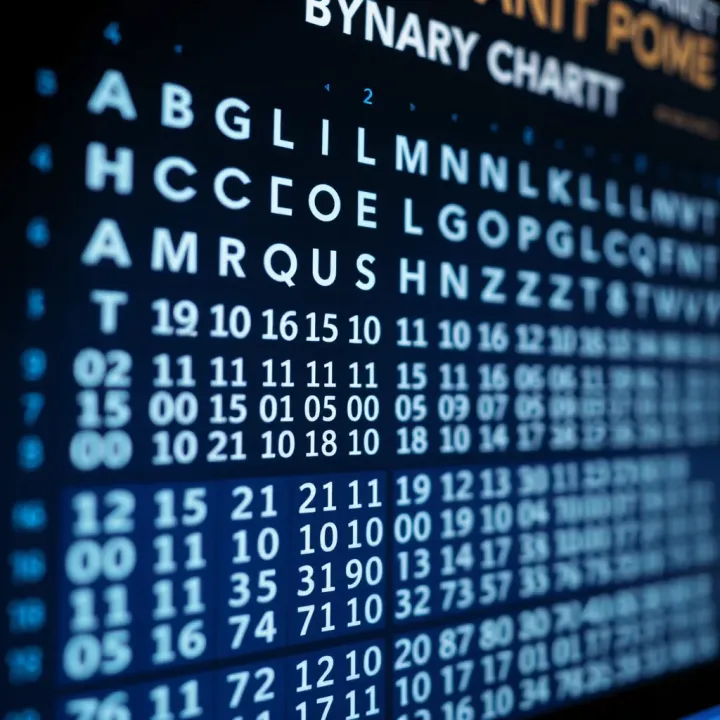
For example, the letter ‘A’ in binary is typically represented as 01000001 in the ASCII (American Standard Code for Information Interchange) system, which is common in programming and data encoding. Each letter from A to Z has a unique 8-bit binary code, forming the binary alphabet chart.
Understanding these codes lets you convert text into machine-readable formats and vice versa, helping in areas from software development to data encryption.
Here’s why this matters for traders and financial analysts:
Digital transaction processing systems encode data in binary, ensuring accuracy and speed.
Software that analyses market data, including algorithmic trading tools, translates symbols and commands into binary instructions.
Knowing binary basics helps in grasping how information flows in platforms like trading terminals or financial APIs.
If you want to create your own binary alphabet chart, start with the ASCII standard. Assign each letter its decimal value and then convert it into an 8-bit binary number. For instance:
Letter: ‘B’ - Decimal: 66
Convert 66 to binary: 01000010
Such exercises sharpen your grasp of digital text encoding and its practicality.
In summary, the binary alphabet chart acts as a bridge between human-readable text and the digital code that computers understand. Whether you are a stockbroker automating order entries or a finance student curious about the inner workings of software, mastering this chart will enhance your insight into digital technologies shaping modern trading and investment.
Grasping the binary number system is essential when exploring how computers handle data, especially text. This system forms the backbone of modern digital technology, enabling everything from basic calculations to complex data processing. Knowing this helps traders and finance professionals alike appreciate how their digital tools operate, ensuring smoother troubleshooting and better communication with IT teams.
Binary code is a way of representing information using just two symbols: 0 and 1. This simplicity comes from the physical reality of computers, where switches are either off or on. These two states get mapped to the numbers zero and one, creating a numbering system called base-2.
To see how this works practically, think about turning a streetlight on and off to send a message. That on/off pattern corresponds to the binary states within a computer. It’s the digital world's language for everything from emails to stock prices displayed on your trading platform.
When compared to the decimal system (base-10), which uses ten digits from 0 to 9, binary is much more basic but incredibly efficient for machines. Decimal suits humans better due to its familiarity, but computers prefer binary since their hardware easily reads two distinct states. This difference explains why even complex data must be encoded in binary behind the scenes.
Bits and bytes are fundamental units in digital systems. A single binary digit is called a bit, representing either a 0 or 1. Since one bit alone offers limited information, eight bits combine to form a byte. Bytes allow computers to express a broader range of values. For example, one byte can represent 256 different combinations, enough to encode a single character like the letter ‘A’.
Understanding bits and bytes offers practical value, such as analysing data sizes on your stock market charts or digital reports. Knowing that a 5MB file contains roughly 40 million bits gives perspective on data management and storage.
The zeros and ones in binary don’t just represent numbers; they indicate electrical states in circuits. A zero might mean no current flow, while one signals a current. This distinction forms the foundation of digital communication, enabling reliable data storage and transmission. Without this binary system, you wouldn't be able to access live stock data or send instant transactions on your mobile.
Binary code forms the language computers use to process and communicate data effectively, making it critical for anyone relying on digital technologies to at least understand its basics.
By knowing how binary works, finance professionals can decode the technical jargon often seen in technology-related discussions, resulting in better decision-making and interactions with tech teams. Whether analysing algorithmic trading software or understanding encryption basics securing online transactions, binary understanding proves its worth.
A binary alphabet chart helps translate each letter of the alphabet into a specific sequence of zeroes and ones. This chart forms a bridge between human-readable text and the language of computers, which only understand binary code. For traders and financial analysts dealing with digital data storage or communication, understanding this chart clarifies how text information is encoded and processed behind the scenes.
By using a binary alphabet chart, one can systematically convert any letter into its equivalent binary code. This clarity is especially useful when analysing encrypted text data or troubleshooting electronic communication systems that rely on binary sequences. In short, the chart provides an essential map connecting alphabets to their binary counterparts, making digital text manipulation more accessible.
Each letter in the alphabet corresponds to a fixed binary pattern. For example, the letter 'A' is often represented by the binary sequence 01000001 in an 8-bit coding system. This direct linking means every character you type on your keyboard translates into a string of bits that computers can store or transmit. For professionals looking to understand data encoding or validate binary data, the chart acts as a reliable reference.
Knowing which binary sequence corresponds to which alphabet letter allows easier decoding of raw digital streams. For instance, if you receive a message encoded in binary, referencing the chart enables translation back into readable text. This is particularly helpful in financial data systems where messages often use alphanumeric codes in electronic trading platforms.
The American Standard Code for Information Interchange (ASCII) is the most common system used to map letters to binary. It uses 7-bit or 8-bit codes to represent characters consistently across computers worldwide. Thanks to ASCII, the letter 'B' translates into 01000010 and 'C' into 01000011, allowing uniform encoding and decoding.
In finance-related software or electronic documents, ASCII ensures that the textual data remains consistent and compatible. Whether you are exporting reports, storing stock symbols, or working with trading algorithms, the binary alphabet chart based on ASCII is the underlying standard, guaranteeing smooth data exchange.
Binary alphabet charts usually come in two main varieties: 7-bit and 8-bit codes. The 7-bit format covers the basic alphabet characters and some control codes, sufficient for standard English text. Meanwhile, the 8-bit format extends this by adding extra characters and symbols, supporting international languages and special signs.
In practical terms, 8-bit codes provide greater flexibility. For instance, a software handling Indian languages or special finance symbols like ₹ might rely on 8-bit or extended encoding systems. Traders and programmers working with diverse alphabets or creating multilingual software would value knowing these formats.
A binary alphabet chart also differentiates between printable and non-printable characters. Printable characters include letters, numbers, and punctuation that appear on screen or paper. Non-printable characters, on the other hand, are control codes used to manage devices or format data, such as line breaks or tabs.
Understanding this distinction is vital when processing electronic messages or scripts. For example, in a trading platform, receiving a non-printable character unexpectedly might indicate an error or a signal command. Recognising which binary sequences map to such control functions helps maintain data integrity and troubleshoot communication problems efficiently.
In essence, the binary alphabet chart is a fundamental tool that translates everyday letters into machine language. For finance professionals, it opens a window into the digital layer behind data, aiding comprehension, programming, and problem-solving in tech-driven markets.
Reading and using a binary alphabet chart is essential for anyone working with digital data, especially in fields like programming or data analysis. It helps you translate between the familiar alphabet and the binary numbers computers understand. This skill is particularly useful when you need to interpret encoded information or ensure accurate data transmission.
The process of converting letters to binary involves mapping each alphabet character to its equivalent binary code, usually based on ASCII encoding. Start by identifying the ASCII value of a letter—for example, the letter 'A' corresponds to 65 in decimal. Next, convert this decimal number into binary, which results in 01000001. Using a binary alphabet chart simplifies this by providing a direct lookup for each letter's binary sequence.
This step-by-step method allows quick and accurate conversion, which proves valuable when dealing with text encoding in programming or data communication. For instance, converting the word "HELLO" into binary is straightforward using the chart:
H: 01001000
E: 01000101
L: 01001100
L: 01001100
O: 01001111
These binary sequences form the digital representation of each letter, ready to be processed by computers.
Decoding binary sequences to letters is the reverse process. You start with a binary string, split it into 7 or 8-bit chunks (depending on the format), and convert each chunk back to a decimal number. Using the binary alphabet chart, you then match the decimal value to its corresponding letter. For example, 01000010 converts to 66 in decimal, representing the letter 'B'.
This decoding process is not just theoretical; it has practical uses in debugging encoded messages, troubleshooting data errors, or understanding communication protocols. For example, if a message encoded in binary fails to display correctly, knowing how to decode it manually can help identify issues related to data corruption or incorrect encoding.
Mastering both converting letters to binary and decoding binary back to letters enhances your ability to interact with digital systems. It bridges human-readable text and machine-level data, making you more confident in handling digital information effectively.
Binary alphabet charts play a significant role beyond just academic understanding; they are fundamental in several real-world applications. These charts help translate text into binary code, which computers and digital systems use to store and process information. Understanding their practical uses gives clarity on how digital communication and data handling take place every day.
Storing and processing text data involves converting alphabetic characters into binary sequences, making it easier for computers to handle. For instance, when you type a message on WhatsApp or compose an email, each letter, number, or symbol you input is immediately converted to binary code according to standards like ASCII or Unicode. This ensures computers can precisely identify and manipulate text.
This conversion is a backbone of all digital text processing. Programmers write software that reads and writes these binary sequences, enabling text storage in databases, memory, or files easily. Without such a system, computers would struggle to handle the diverse languages, symbols, and formats we use daily.
Communication protocols depend heavily on binary encoding to transmit data accurately. Networking standards such as TCP/IP send text data in binary form over the internet and other communication lines. For example, when stockbrokers use electronic trading platforms, the buy or sell commands they enter are sent as binary sequences, ensuring fast, error-free communication between client terminals and exchange servers.
Binary charts support encoding messages for data transfer, error detection, and correction algorithms. They act as a universal language for machines, making it possible to connect devices from different brands and systems seamlessly.
Teaching digital literacy starts with familiarising learners with basic binary concepts, making binary alphabet charts an excellent educational tool. For students or finance trainees exploring how computers work behind the scenes, understanding binary helps demystify how data is processed.
By practising conversions between letters and binary, learners develop a concrete grasp of how digital devices interpret human-readable text. This foundation proves handy when dealing with spreadsheet software, programming basics, or even mobile app interfaces common in day-to-day financial analytics.
Understanding computer basics becomes straightforward when one sees how alphabets translate to zeros and ones. This knowledge bridges the gap between abstract computing concepts and tangible examples. For instance, IT instructors in banking courses often use binary charts to explain character encoding schemes employed in automated teller machines (ATMs) and online banking portals.
Such clarity lets students appreciate the layers of technology involved in what seems like simple text entry on screens.
Binary codes in encryption utilise these charts in converting text into coded messages. Many encryption algorithms transform alphabets into binary and apply mathematical operations to secure sensitive data, such as transaction details or confidential investor information.
Consider secure messaging apps: they encrypt entered text by manipulating its underlying binary representation. This process makes the original message unreadable without the correct decryption key, thus protecting private data from unauthorised access.
Using binary in puzzles and games adds an engaging dimension to learning and recreation. For example, escape rooms or puzzle contests sometimes require decoding hidden messages written in binary, challenging participants to convert binary strings back to alphabets.
This practice sharpens problem-solving skills and encourages familiarity with how computers and data encoding work in a fun, interactive way. Finance students solving logic puzzles with binary codes often find that it improves their analytical thinking, useful for complex data analysis or algorithmic trading.
Mastering binary alphabet charts not only supports technical proficiency but also opens doors to understanding core digital processes relevant in trading, security, education, and entertainment.
By recognising these practical applications, finance professionals gain deeper insights into the tech that underpins today’s data-driven world.
Explore binary fission 🔬, the simple asexual reproduction in bacteria and protozoa, with examples, biological importance, and comparisons to other methods.

Learn how numbers work in binary code 💻 Explore binary basics, conversions to decimal, and their everyday uses in technology for better computing insights 🔢

📊 Learn how to decode binary into readable text with clear steps, common encoding standards, practical tools, and real-world computer applications in India’s digital space.

📊 Explore binary number tables: how to read, build, and convert between decimal and binary. Key for students, engineers, and tech enthusiasts working with digital systems.
Based on 9 reviews